• Home
  • About
  • Blog
  • Courses
  • Meet Ups
  • Book Shop
  • Store
  • Contact
UNDERSEA NATURALIST
  • Home
  • About
  • Blog
  • Courses
  • Meet Ups
  • Book Shop
  • Store
  • Contact

The Blue-Footed Booby

9/1/2023

0 Comments

 
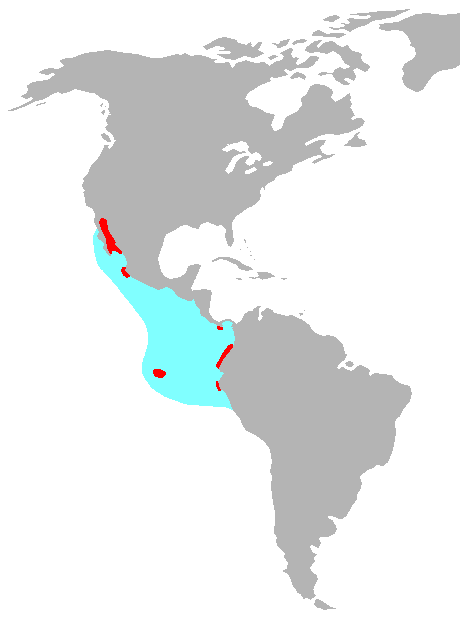
​The blue-footed booby (Sula nebouxii) is a large, charismatic seabird that is found in the tropical and subtropical eastern Pacific Ocean.  It is one of three booby species found on the Galapagos Islands, and is perhaps the most famous of all the Galapagos birds. From the Galápagos Islands their geographic range extends northward to the coast of Baja California and western the coasts of Central and South America.
 
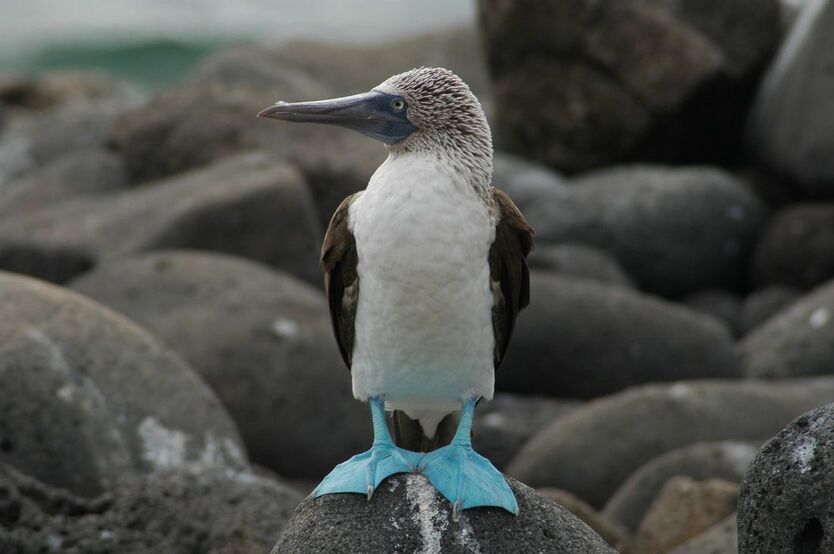
The most distinctive feature of the blue-footed booby is its bright blue feet. The color of the feet comes from a pigment called pteridine, which is also found in the feathers of other birds, such as the scarlet macaw.  The blue-footed boobies' diet plays a significant role in the coloration of their feet. These birds primarily feed on fish, particularly species like sardines and anchovies. The fish they consume contain pigments called carotenoids, which are responsible for various colors in nature, including the blues and greens seen in many birds. The carotenoids from their fishy diet are metabolized by the birds' bodies and accumulate in the skin, particularly in the feet, resulting in the blue coloration.
 
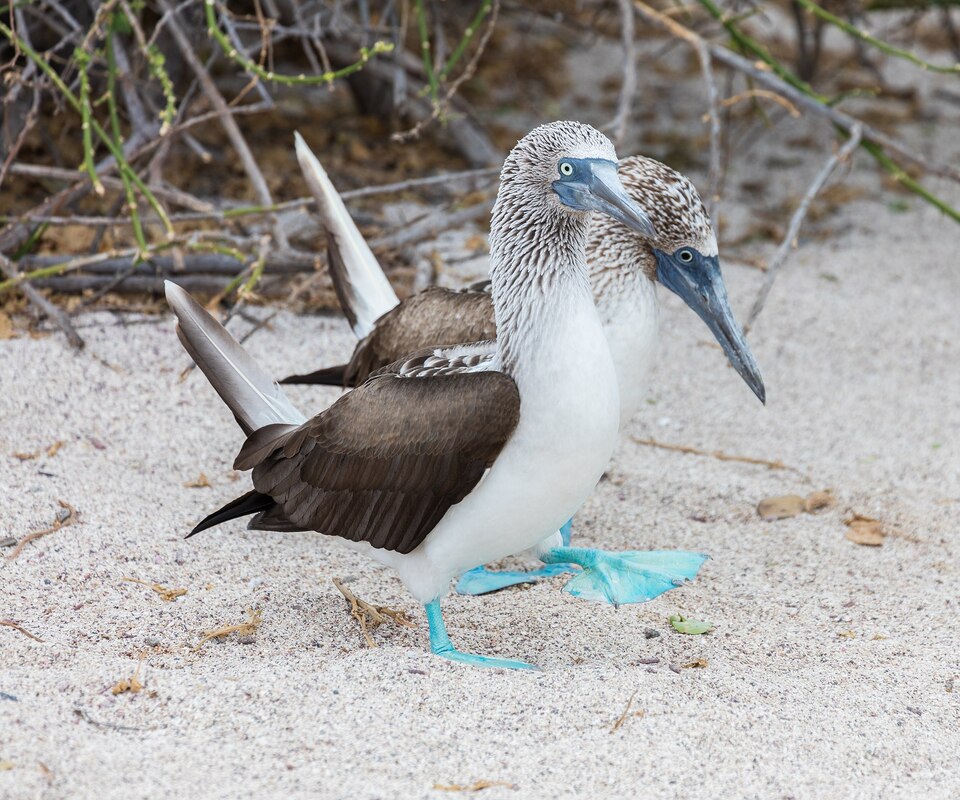
The intensity of the blue color in a blue-footed booby's feet is directly related to its health and nutritional status. A more vibrant blue color indicates a healthier individual with access to a diet rich in carotenoids. This coloration serves as a visual signal to potential mates during courtship. Males with brighter blue feet are perceived as more attractive and capable of providing for their partners and offspring.  During mating rituals, male birds show off their feet to prospective mates with a high-stepping strut.
 
Blue-footed boobies are one of the few bird species that can actually blush.  When a male booby is feeling particularly proud of his feet, he will often blush blue. This is thought to be a way of attracting the attention of potential mates.
 
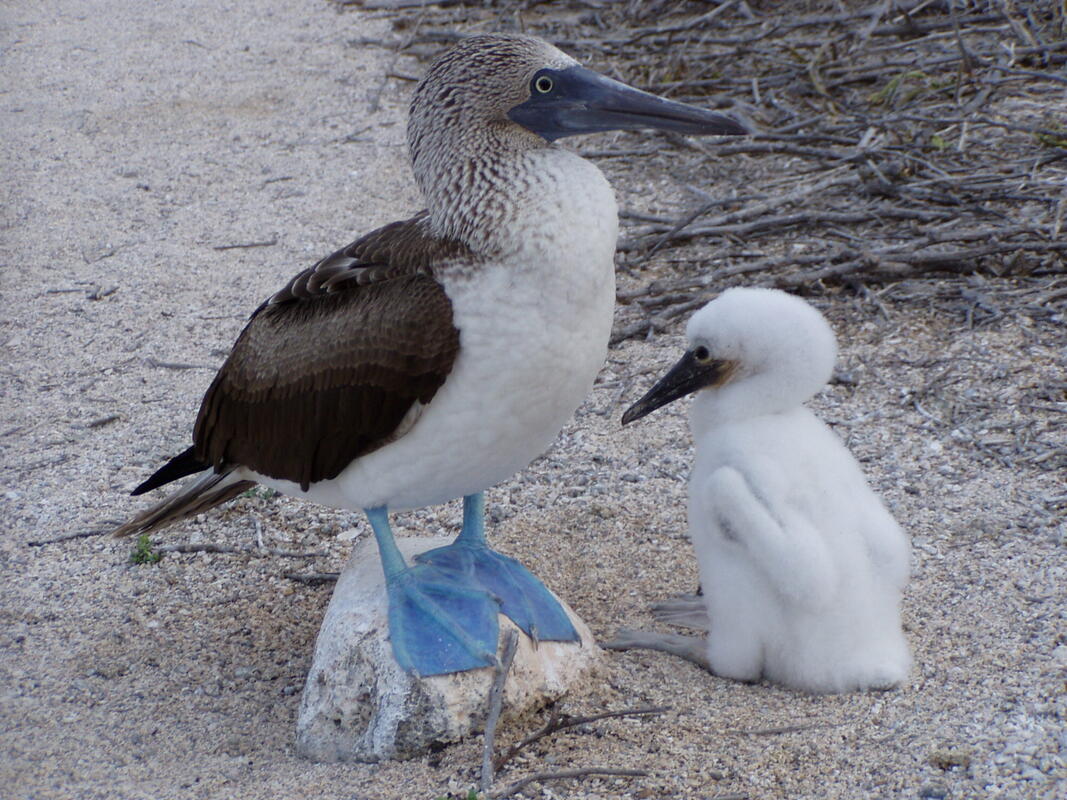
The blue-footed booby breeds year-round. The male and female birds build a nest together where the female lays one to three eggs.  Both parents incubate the eggs which hatch after about 45 days and both parents are involved in feeding.  The first hatch chick usually establishes a dominance hierarchy and is the recipient of the majority of the food.  Fratricide by the older chick is also not uncommon.  Surviving chicks will fledge after about 102 days.  Parents continue to provide food until the chicks are fully independent.
 
Blue-footed boobies spend the night ashore in their nest and when day breaks they take to the air in search of seafood, often fishing in large, cooperative groups.  Eye placement on both sides of the bill with a forward orientation gives these birds excellent binocular vision, essential for hunting fish from the air
 
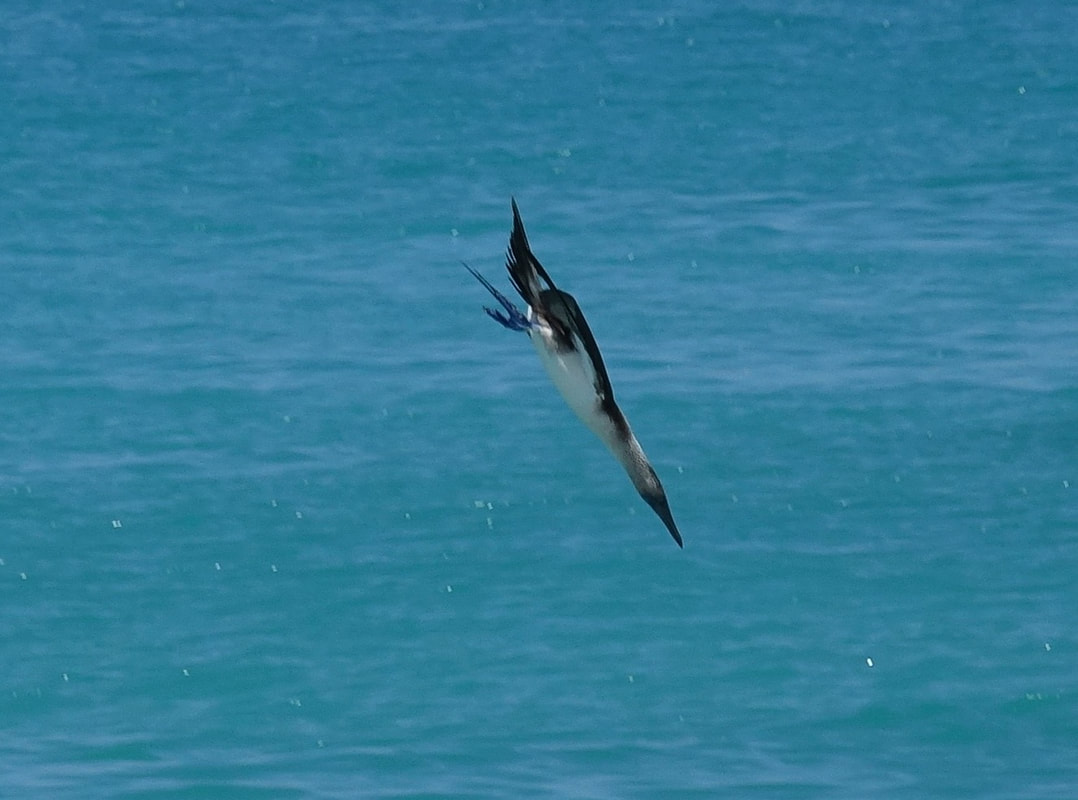
They feeding primarily by plunge diving.  Once prey are spotted they will fold their long wings back around their streamlined bodies and plunge into the water from as high as 24 meters (≈ 80 ft).  Their speed entering the water reaching 96 km/hr (≈ 60 mile/hr).  Adaptions to such a violent entry include padding in the form of subcutaneous fat, well-developed air sacs and closed external nostrils.
 
The pursuit of a meal may take them as deep as 20 M (≈ 65 ft). Prey items are pelagic fish such as pilchards (Sardinops caeruleus), chub mackerel (Scomber japonicus), anchovies (Anchoviella sp.) and flying fishes (Exocoetus sp.). 
 
The origin of the name "booby" is believed to be derived from the Spanish word "bobo," meaning foolish or clownish.  The clownish nature of these graceful flyers’ gait on land is one possible source of the name, with the other being the  birds’ foolish choice of landing on sailing ships where their awkwardness made them easy sources of fresh food for sailors. 

Picture
An Adult Bird 
Photo by Dave Govoni at Flickr - https://www.flickr.com/photos/dgovoni/2187740986
https://www.flickr.com/.../dgo.../2187740986/in/photostream/


Picture

Close Up of Feet
Photo by putneymark, CC BY-SA 2.0 <https://creativecommons.org/licenses/by-sa/2.0>, via Wikimedia Commons
Picture
Blue-Footed Booby Mating Dance. 
Photo by Diego Delso, CC BY-SA 4.0 <https://creativecommons.org/licenses/by-sa/4.0>,via Wikimedia Commons https://commons.wikimedia.org/wiki/File:Piquero_patiazul_(Sula_nebouxii),_isla_Lobos,_islas_Gal%C3%A1pagos,_Ecuador,_2015-07-25,_DD_34.JPG

Picture
Adult and Chick
Photo by Dan from https://www.flickr.com/photos/twiga_swala/2285294749
Picture
Diving Blue-Footed Booby
​Photo by Mike's Birds from Riverside, CA, US, CC BY-SA 2.0 <https://creativecommons.org/licenses/by-sa/2.0>, via Wikimedia Commons https://commons.wikimedia.org/wiki/File:Blue-footed_booby_(47937627992).jpg

Picture
Distribution Map of Blue-Footed Booby: Red indicates nesting areas and blue indicates feeding areas. 
Map by  Jonathan Hornung, Public domain, via Wikimedia Commons - https://commons.wikimedia.org/wiki/File:Blaufu%C3%9Ftoelpel_(Sula_nebouxii)_world2.pngDistribution Map of Blue-Footed
0 Comments


Leave a Reply.

Powered by Create your own unique website with customizable templates.
  • Home
  • About
  • Blog
  • Courses
  • Meet Ups
  • Book Shop
  • Store
  • Contact